
Octave machine · in the Japanese brown-box tradition
Sledgehammer
Two legendary octave circuits in one walnut box — the brown-box analog sub done properly, and a clean octave-up that is mathematically incapable of going out of tune.
◆ macOS 12+ · Apple Silicon · AU / VST3 / Standalone
What it is
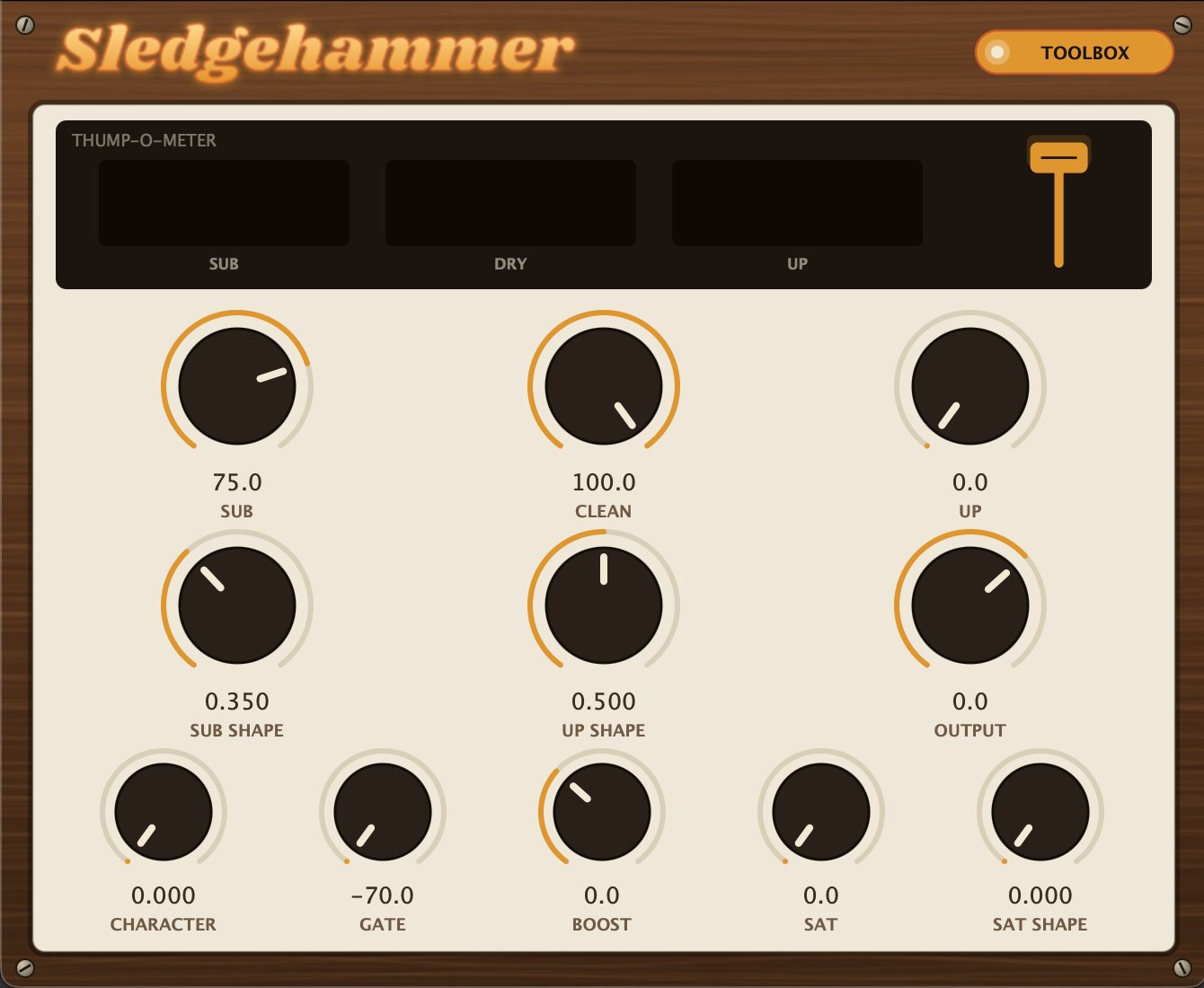
The sub voice is a genuine flip-flop divider — the same architecture as the beloved Japanese brown box. It tracks your note, toggles a square wave at half the frequency, and rides your playing dynamics, complete with the authentic gargle when you feed it chords or dig too low. Shape it from pure sine-like sub to bright square-wave snarl.
The up voice takes a different path from every granular shifter you have heard warble: an analytic-signal frequency doubler produces exactly one octave up — monophonic, perfectly in tune, zero latency. Open the Toolbox and the pedal physically extends to reveal the up voice's workshop: morph from glassy-clean to hairy rectifier fuzz, gate it, boost it, saturate it. Three glowing meters and a hammer ready to drop. Trust us.
Why you'll reach for it
A real divider sub
The brown-box flip-flop circuit, glitches and all — they are a feature, not a bug.
Always in tune
Analytic-signal doubling means the octave-up cannot go out of tune. Not rarely. Cannot.
Zero latency
Every voice is sample-accurate with no added latency — play tight, stay tight.
The Toolbox
The pedal extends to reveal Character, Gate, Boost, Sat and Sat Shape for the up voice.
Character morph
Sweep from clean octave shimmer into Green Ringer / Octavia rectifier hair.
Voiced for bass
A band-pass shape on the octave-up tuned so it never goes glassy on low notes.
Hear it
Dry, then Sledgehammer.
An A/B bass demo drops in here before launch. Record dry, then wet, settings shown — 30–60 seconds.
Specs
| Type | Octave machine (sub + octave-up + dry) |
|---|---|
| Formats | Audio Unit, VST3, standalone app |
| Platform | macOS 12+, Apple Silicon (M1 or newer) |
| Channels | Mono or stereo · 44.1–192 kHz · 64-bit host |
| CPU | Very low — allpass network + two filters; no FFT, no lookahead |
| Presets | Factory programs (incl. Octavia) via the host preset menu |
Under the Hood — what was cloned, and why
Sub voice (brown-box divider architecture): the input passes through a cascaded low-pass tracking filter to isolate the fundamental, into a hysteresis comparator whose threshold scales with the playing envelope to reject chatter. Each detected cycle toggles a flip-flop, producing a square wave at exactly half the input frequency; this is then multiplied by the input's envelope so the sub breathes with your dynamics. The tracking errors on chords and extreme low notes are preserved, not patched — they are the circuit behaving as the original does.
Up voice (analytic-signal doubler): instead of granular pitch-shifting (whose grain-crossfade smears sidebands around every note), Sledgehammer computes the analytic signal via a wideband IIR Hilbert phase-splitter and applies a trigonometric identity. The output frequency is exactly twice the input by mathematics: no grains, no warble, no latency. A 650 Hz pre-filter biases the doubler toward the fundamental, keeping intermodulation on rich basses musical.
The Toolbox chain — character blend to a full-wave rectifier, then gate, boost, and a symmetric-to-asymmetric saturator — restores harmonic life to the pure doubler's near-sinusoidal output, exactly as the analog units' transistor stages do.