
Silicon fuzz · cloned from one-off hardware
Ice Age
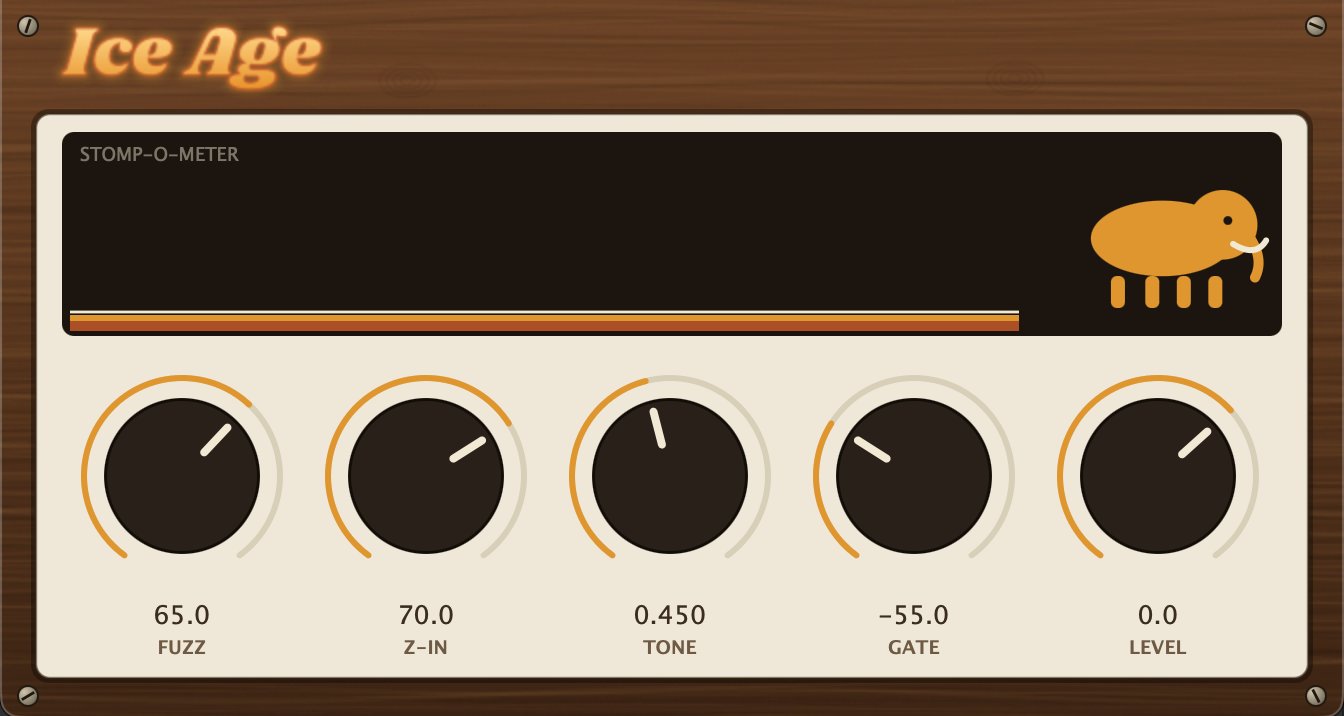
A woolly-mammoth-sized silicon fuzz, cloned by measurement from a one-off hardware build: smoother than its forefathers, with all of its low end intact and a Z-In control that goes from polite to feral.
◆ macOS 12+ · Apple Silicon · AU / VST3 / Standalone
What it is
Ice Age began life as a piece of custom hardware — a Fuzz Face–lineage silicon fuzz voiced for bass — and was cloned by measurement: drone recordings at documented knob positions, analysed, and rebuilt control by control. The result keeps the brief on the tin: smoother than its forefathers, retaining huge low end. There is no high-pass filter anywhere in the path; your fundamental hits the clippers intact.
Two cascaded soft-clipping stages deliver sustain without rasp. Z-In is the personality knob, measured from the hardware: dynamic and articulate at low settings, slammed and compressed at full, with the bias point shifting alongside for richer harmonics as you push. The Tone control carries the measured curve of the original — a drastic tilt from sub-heavy doom to scooped clarity — while a fixed dark voicing keeps even the brightest settings smooth. One row of five knobs. A mammoth that stomps when you do. Tundra not included.
Why you'll reach for it
Low end intact
No high-pass anywhere in the path — your fundamental arrives whole and leaves whole.
Smooth, never fizzy
Two-stage silicon clipping with bias-coupled even harmonics.
Z-In: polite to feral
A measured 13 dB → 6 dB crest collapse on one knob.
The measured tone curve
±15 dB of lows, +30 dB of opened top — and still never harsh.
Sputtery gate
An 18 ms release tuned for that gated-fuzz stutter.
A stomping mammoth
The meter rears back and trumpets when you dig in.
Hear it
Dry, then Ice Age.
An A/B bass demo drops in here before launch. Record dry, then wet, settings shown — 30–60 seconds.
Specs
| Type | Silicon fuzz / distortion |
|---|---|
| Formats | Audio Unit, VST3, standalone app |
| Platform | macOS 12+, Apple Silicon (M1 or newer) |
| Channels | Mono or stereo · 44.1–192 kHz · 64-bit host |
| CPU | Trivial — a handful of one-pole filters and two tanh stages per channel |
| Presets | Factory programs via the host preset menu |
Under the Hood — what was measured, and why
Ice Age was calibrated against drone recordings of the source hardware with knob settings documented per file. Spectral and crest-factor analysis established that the Z-In control functions as input drive into the clipper rather than a filter: at maximum, crest factor collapses from ~13 dB to ~5.6 dB with sustain rising ~10 dB. So Z-In is a 0.3×–4× input gain with partial level compensation, and the clipper's bias offset is coupled to it, shifting the operating point for richer even-harmonic content as Z rises.
The clipper itself is two cascaded tanh stages — a biased asymmetric first stage for the silicon even-harmonic signature, into a gentler symmetric second — echoing the two-transistor Fuzz Face topology. The Tone control reproduces the measured wet tilt: a 2nd-order state-variable morph at ~450 Hz with a band-pass term filling the crossover, spanning the measured −15 dB low swing and +30 dB top-end swing, followed by a fixed ~2.2 kHz roll-off because the hardware stays dark even wide open.
The gate is keyed from the input envelope with a fast open and an abrupt 18 ms close for the gated-fuzz sputter.