
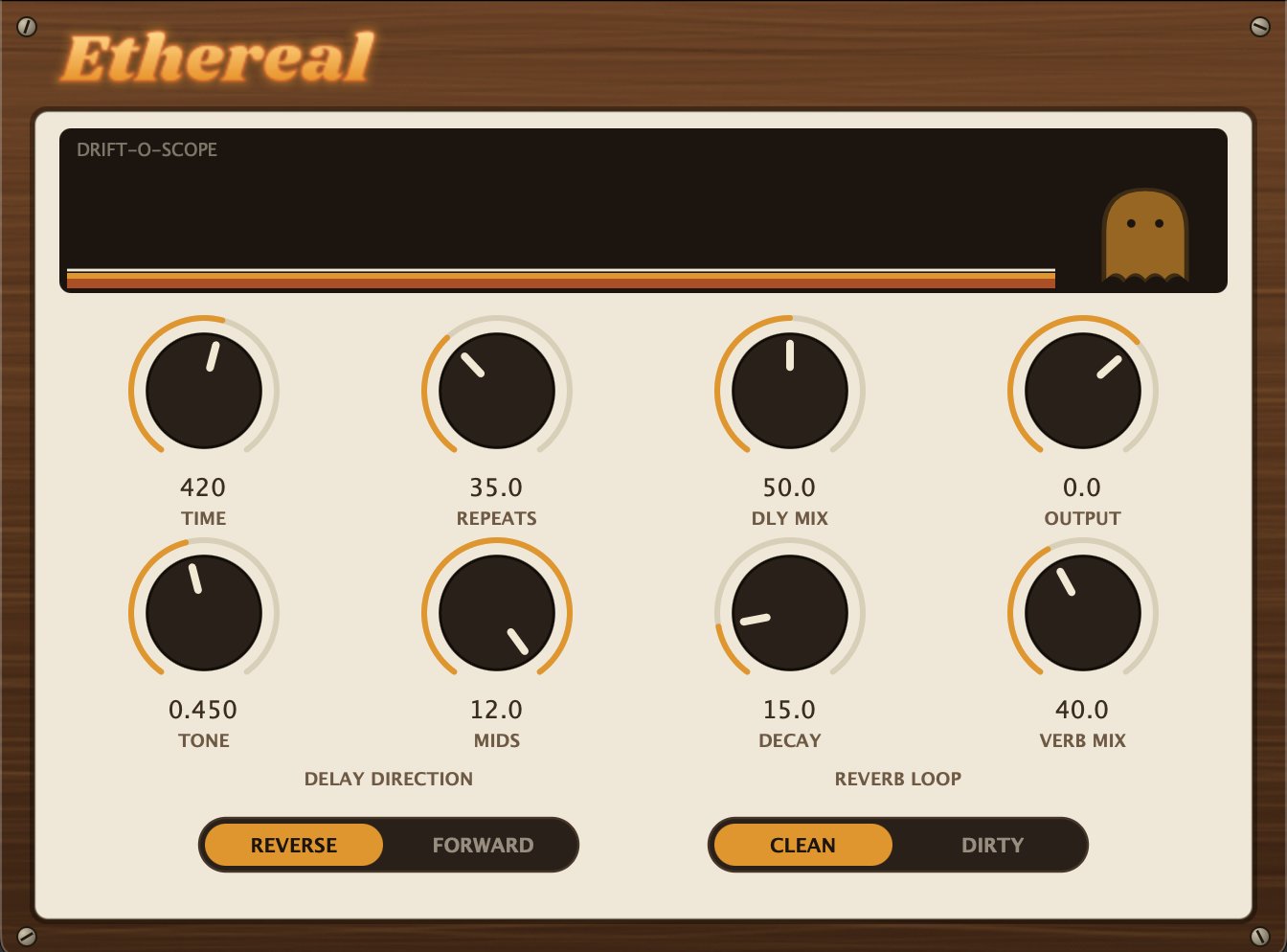
Reverse octave delay → reverb · the flagship
Ethereal
An octave-up reverse delay feeding a digital reverb cloned — measurement by measurement — from a one-off piece of custom hardware. Subtle at one end; a self-oscillating noise machine at the other.
◆ macOS 12+ · Apple Silicon · AU / VST3 / Standalone
What it is
Ethereal is two instruments in series. The delay reads its buffer backwards at double tape speed, so everything you play returns reversed and an octave up in a single mechanical move — fully polyphonic, because it is variable-speed playback, not pitch detection. Chords shimmer. Regeneration climbs octave over octave into the light. Flip the rocker for a conventional forward delay.
The reverb behind it is something rarer: a clone of a custom-built hardware unit that exists in exactly one enclosure, reconstructed from a measurement campaign — decay times, filter curves, self-oscillation behaviour, headroom tests, the lot. Its feedback knob runs from tight ambience through second-long bloom into genuine self-oscillation just past noon, pinning into a pitched, harmonic drone at the top. And because the cloning process produced one gloriously wrong version along the way, the REVERB LOOP rocker keeps it: CLEAN is the hardware; DIRTY is the saturating, intermodulating alter ego we could not bring ourselves to delete.
Why you'll reach for it
Octave-up reverse delay
Reversed at double speed = polyphonic octave-up reverse. No pitch tracking, no warble.
Shimmer that ascends
Regeneration climbs an octave per repeat, into the light.
A measured reverb clone
Decay law, filter curves and drone pitch, all reconstructed from one-off hardware.
Self-oscillating drone
Just past noon it blooms into a pitched, harmonic drone — not noise. We measured the difference.
Wet-only tone & mids
From full-bodied resonance to cold hard-wall, with up to +28 dB of vocal mid resonance.
CLEAN / DIRTY loop
The faithful clone, or its saturating evil twin, on a rocker.
Hear it
Dry, then Ethereal.
An A/B bass demo drops in here before launch. Record dry, then wet, settings shown — 30–60 seconds.
Specs
| Type | Reverse octave delay into reverb |
|---|---|
| Formats | Audio Unit, VST3, standalone app |
| Platform | macOS 12+, Apple Silicon (M1 or newer) |
| Channels | Mono or stereo · 44.1–192 kHz · 64-bit host |
| CPU | Low — 12 modulated combs, 12 allpasses, a few filters; no convolution, no FFT |
| Reverb tail | Reports an 8-second tail to hosts for correct bounce/freeze behaviour |
Under the Hood — the saga, condensed
The delay reads a circular buffer backwards at 2× write speed through two equal-power crossfaded grains. Double-speed reversed playback transposes everything up an octave as a side effect of the read rate — which is why it is inherently polyphonic and tuning-perfect, unlike pitch-shifter approaches. Regeneration writes the wet signal back into the same buffer, so each repeat is reversed and raised again: the characteristic ascending shimmer.
The reverb was reverse-engineered from the source hardware through a staged measurement campaign — feedback sweeps locating self-oscillation onset and a stable low drone with a single 3rd harmonic; staccato impulses fixing decay times; wet-only control sweeps yielding the tone morph and the +28 dB mid bell; a +18 dB headroom test proving the loop is linear with large headroom; and chordal material revealing the hardware's swell as delay-line modulation rather than discrete echo.
The resulting architecture: pre-delay into an allpass diffuser; six modulated feedback combs per channel with slow per-comb LFOs that decorrelate the channels and produce the breathing; a low shelf inside the loop so lows cannot regenerate uncontrollably; and a decay-gated soft limiter that permits feedback beyond unity to bloom into the measured drone — while staying out of the circuit at playable settings. The DIRTY mode preserves an earlier in-loop saturating design as a creative alternative.