
Envelope filter · stretchin’ out since the ’70s
Jellikins
A 70s-soul envelope filter with a continuously morphable LP–BP–HP filter, onboard drive, and a UI that dances when you do.
◆ macOS 12+ · Apple Silicon · AU / VST3 / Standalone
What it is
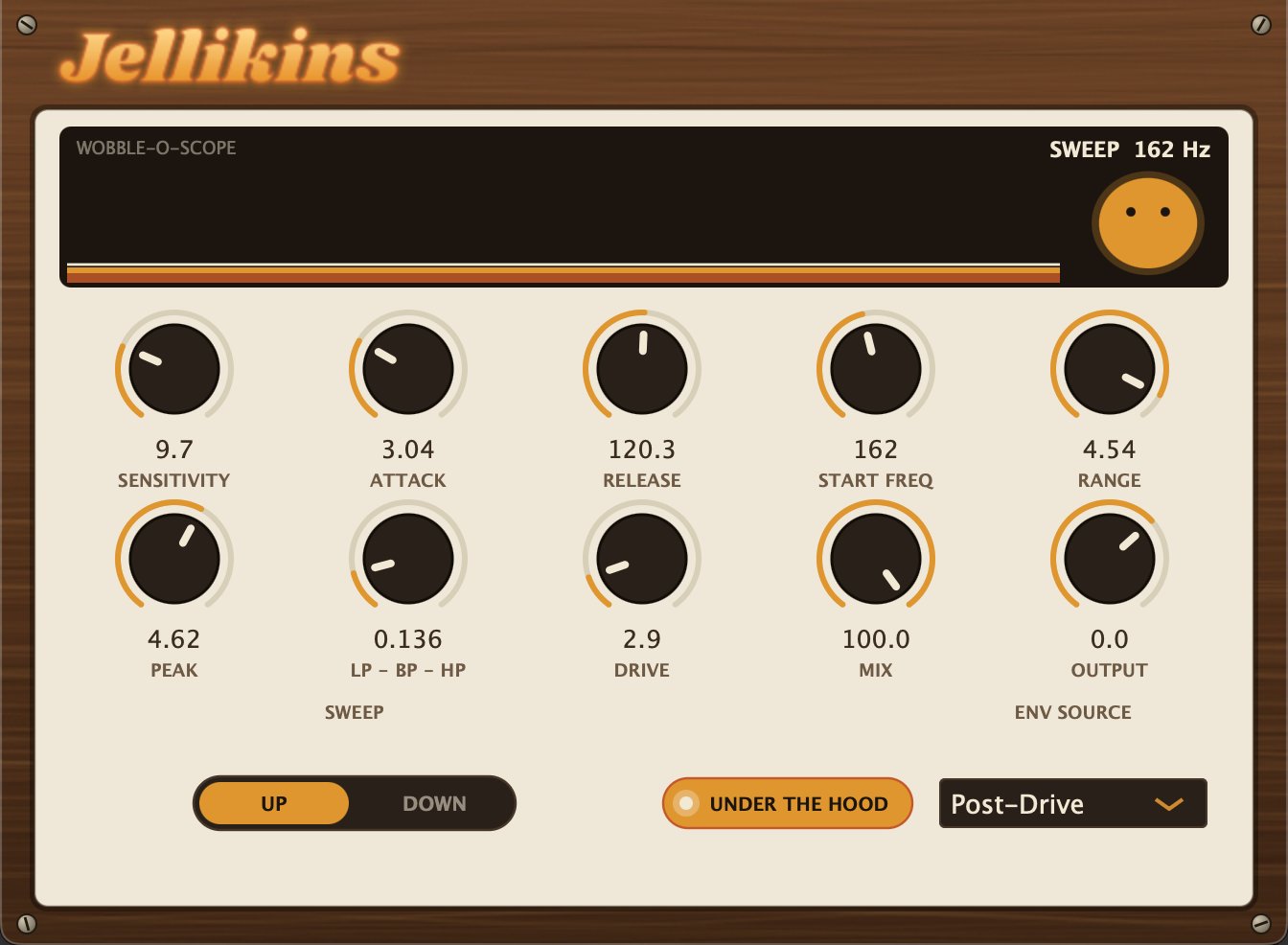
Jellikins is the envelope filter your bass has been asking for. A fast, musical envelope follower tracks your playing and sweeps a zero-delay-feedback filter across up to five octaves — dig in for the classic up-quack, or flip the rocker for the down-sweep squelch that made 70s funk records breathe.
Where the original hardware made you choose between low-pass, band-pass and high-pass, Jellikins puts them on one knob: morph continuously from round and vocal to thin and percussive. A soft-clipping drive stage adds grit and sustain, and the envelope can listen pre- or post-drive — tucked away Under the Hood, where tweakers will find it. The Wobble-O-Scope shows your envelope in 70s sunset stripes, the jelly dances, and the logo glows brighter the harder you play. Cream, walnut, and amber. Plug in, turn up, get down.
Why you'll reach for it
One morph knob
The classic three-way filter switch, melted into a single continuous LP–BP–HP sweep.
Up & down sweep
A proper rocker switch picks funk quack or synth squelch. No menus.
Drive with brains
Soft-clip drive, with the envelope switchable pre- or post-drive Under the Hood.
Smooth at any Q
A zero-delay-feedback filter core — no digital zipper, even at high resonance.
A jelly that dances
The Wobble-O-Scope moves with your envelope, and the logo breathes as you dig in.
Hand-dialled presets
Factory programs voiced for fingerstyle bass, through your host's native preset menu.
Hear it
Dry, then Jellikins.
An A/B bass demo drops in here before launch. Record dry, then wet, settings shown — 30–60 seconds.
Specs
| Type | Envelope filter |
|---|---|
| Formats | Audio Unit, VST3, standalone app |
| Platform | macOS 12+, Apple Silicon (M1 or newer) |
| Channels | Mono or stereo · 44.1–192 kHz · 64-bit host |
| CPU | Negligible — single SVF + envelope follower per instance |
| Presets | Factory programs via the host preset menu |
Under the Hood — what was modelled, and why
Jellikins follows the architecture of classic optical envelope filters: a full-wave envelope detector with independently variable attack (0.1–100 ms) and release (5–800 ms) drives the cutoff of a 2-pole resonant filter along an exponential, per-octave frequency law from a settable start frequency across a 0–5 octave range. That exponential mapping is what makes the sweep sound musical rather than linear-synthetic.
The filter core is a Zavalishin TPT (topology-preserving transform) state-variable filter — a zero-delay-feedback structure whose resonance behaviour under fast modulation matches analogue SVFs, which matters because an envelope filter's whole personality lives in how the resonant peak moves. The three outputs (LP / BP / HP) are crossfaded continuously, generalising the original's mode switch into a morph.
Drive is a tanh soft-clipper placed before the filter, as in the classic units, where the filter tames the clip harmonics. The envelope detector is switchable pre- or post-drive: post-drive detection compresses the sweep response for consistency; pre-drive tracks raw playing dynamics.
Questions, answered
The funk FAQ.
Is this the same as an auto-wah?
NO! They are very different effects. Auto-wah copies are often marketed as envelope filters, or envelope filters referred to as auto-wahs. They are two distinct effects. An auto-wah "wahs" based on an LFO — basically wah'ing to a consistent rhythm. Envelope filters listen to what you're playing and respond to your dynamics.
Can my FabFilter XYZ900 do the same thing?
Idk, probably. Go and menu/parameter-dive for a few hours and lose your funk.
Does my Anagram already do this?
Yeah, but poorly. For some reason, nobody has figured out modelling an envelope filter properly on modelling devices. We see people saying that splitting your signal 19 different ways and combining it with a bunch of pedals gets you 30% of the way to the sound. Bootsy never used 30% of a Mu-Tron, and neither should you.
Does this work on Windows?
Nope. Email us at windows@derogatorypig.com with the plugin name as the subject, and we'll add you to the list to let you know once we figure that out.
Does this work on Intel Macs?
We thought they'd all died by now. Not at this point — but email us at intel@derogatorypig.com, and if enough have outlasted the dreaded ticking clock the Geniuses set, we'll get it done and let you know.
What envelope filters should I check out?
The Mu-Tron III, 3Leaf Proton, Lovetone Meatball, Melos MU-1000 — and this plugin.
What envelope filters shouldn't I check out?
The EHX Bassballs — unless you're Flea.
What are the best envelope-filter songs?
Almost anything by Bootsy — "Stretchin' Out," "Ahh, the Name's Bootsy, Baby," "I'd Rather Be With You" — plus "Dukey Stick," "Them Changes," "Funkentelechy," "Blow Your Mind," "Friend Zone," and "Do You Wanna Dance."
Is this just for bass?
We made it with bassists in mind and tested it only with basses — but it's adaptable enough to be fine on any input with a little tinkering.